
Africa International University (AIU) was represented by Dr. Jared Maranga Mayieka at a three-day national Policy Dialogue on the Development of an Artificial Intelligence Framework for Higher Education in Kenya, bringing together representatives from approximately 54 universities to help shape the future of responsible AI adoption in the country’s university sector.
The dialogue, held from 18–20 August 2026 at the CBK Institute of Monetary Studies, Nairobi, was convened by the Commission for University Education (CUE) and funded by the German Academic Exchange Service (DAAD) through the Dialogue on Innovative Higher Education Strategies (DIES) programme.
The forum brought together university representatives, CUE, the Ministry of Education and other higher-education stakeholders in a structured co-creation process aimed at developing the building blocks of a national framework to guide the responsible, equitable and effective adoption of Artificial Intelligence in Kenyan universities.
AIU’s participation placed the University within an important national conversation that is increasingly moving beyond the question of whether universities should use AI to the more consequential question of how AI should be integrated into teaching, research, university operations and national development while protecting academic quality, human agency, equity, privacy and institutional accountability.
Over the three days, participants examined the current state of AI adoption within Kenyan higher education, lessons from international experience, desired outcomes for the university sector, institutional capabilities required to achieve those outcomes, and the wider enabling conditions that universities will require.
An emerging architecture discussed during the dialogue provisionally consolidates AI adoption around four broad areas: Teaching, Learning and Assessment; Research and Innovation; Institutional Operations and Administration; and National Development and Public Value.
The discussions emphasized that AI should not be viewed merely as another technology platform. Its adoption has implications for how universities teach, assess students, conduct research, manage institutional processes, develop graduate capabilities and contribute to society.
A major theme was the need to rethink teaching, learning and assessment in an environment where students and faculty increasingly have access to generative AI tools. Rather than relying primarily on prohibition or AI-detection technologies, universities were encouraged to strengthen approaches that demonstrate authentic learning and competence.
This includes greater use of assessment processes that make student thinking visible through demonstrations, oral defence, project development, reflection, iterative work and other forms of evidence that can distinguish legitimate AI assistance from substitution of the learning that students are expected to undertake themselves.
Universities will need clear governance arrangements for AI use, strengthened data protection and cybersecurity, accountability for AI-supported decisions, appropriate human oversight and role-specific AI literacy among students, academic staff, administrators and institutional leaders.
Equity emerged as another central concern. Where an institution requires students to use a particular AI capability for learning or assessment, access should not depend exclusively on a student’s personal ability to purchase premium tools.
The discussions therefore highlighted the importance of developing approaches that allow institutions with different levels of resources to participate meaningfully in AI-enabled higher education.
This led to another important conclusion: not every university needs to build every AI capability independently. Shared infrastructure, inter-university collaboration, common assurance mechanisms, sector-level expertise and partnerships with industry and national institutions will become increasingly important as AI adoption expands.
During the dialogue, Dr. Jared Maranga Mayieka represented Africa International University in the structured working sessions, contributing to discussions on institutional outcomes, capabilities, responsible AI adoption and enabling conditions.
He was also officially selected to develop the proceedings of the entire three-day Policy Dialogue, documenting the discussions, emerging proposals, key policy signals and framework-development process for subsequent review.
The dialogue was deliberately designed as a co-creation process, with participating universities contributing directly to the evidence and building blocks that will inform development of the national framework.
For Africa International University, the national dialogue provides an opportunity to assess and progressively strengthen its own readiness for an AI-enabled higher-education environment.
One priority will be faculty and staff capability development. Effective adoption will require lecturers who can use AI appropriately, redesign learning experiences and assessments, evaluate AI-generated content critically and help students understand both the potential and limitations of AI.
AIU will also need to continue examining its institutional AI governance, including responsible use, privacy, data protection, cybersecurity, procurement, accountability and human oversight.
The University has an opportunity to strengthen student AI literacy, ensuring that graduates are not simply users of AI tools but are able to question outputs, verify information, understand ethical implications and apply AI responsibly within their disciplines and professions.
Assessment practices will equally need continued attention. As generative AI becomes more capable, the University will increasingly need to ensure that assessment demonstrates what students actually know and can do rather than only evaluating the quality of a final submitted product.
AIU can also explore opportunities for shared infrastructure and strategic partnerships, including leveraging national and sector resources where these can provide more sustainable access to computing capacity, specialist expertise and emerging AI services.
Beyond adoption, the University has an opportunity to strengthen its position as a contributor to AI research, innovation and locally relevant solutions, particularly in areas where technology can respond to African social, educational, economic and institutional challenges.
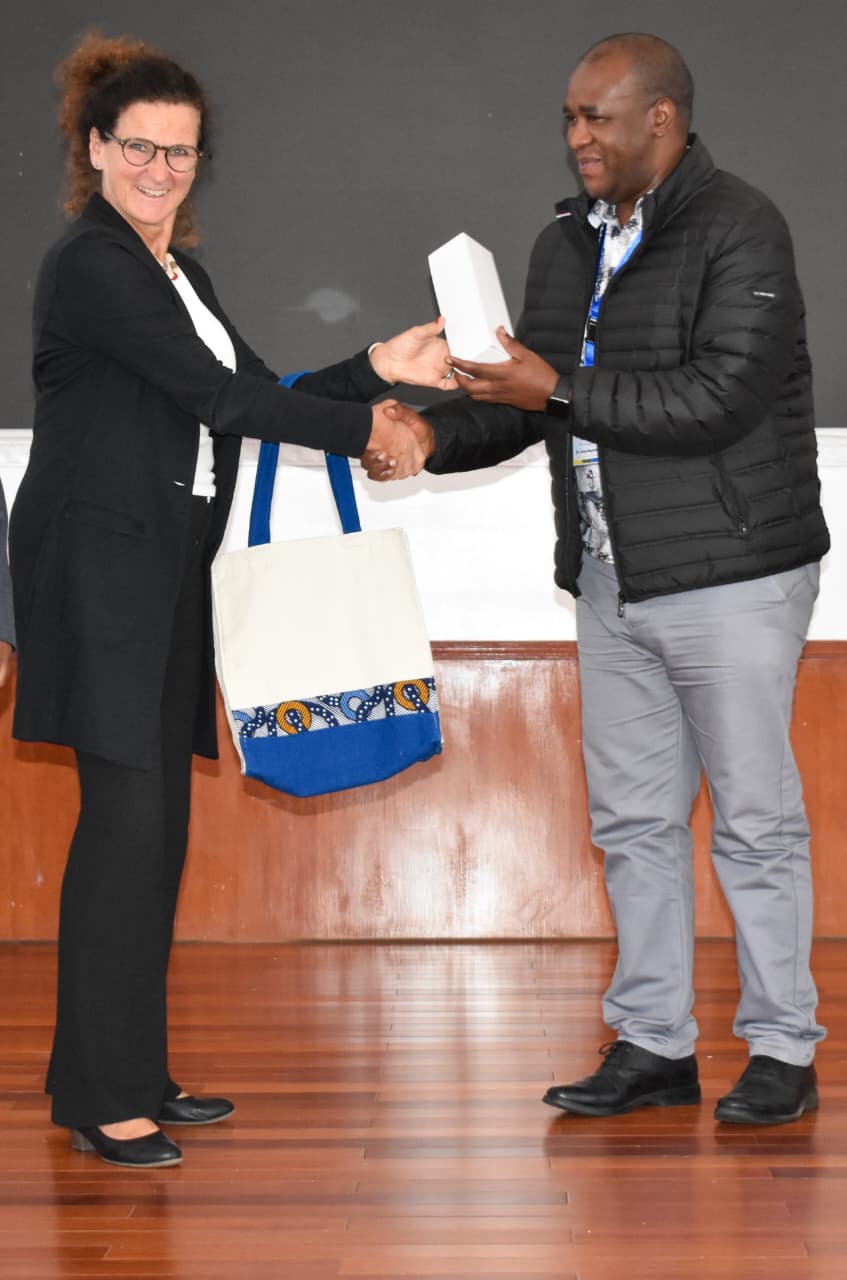
The conclusion of the three-day engagement marks the beginning of the drafting phase rather than the end of the process.
At the formal close of the dialogue, Darius Mogaka Ogutu, Director of Higher Education, challenged universities to continue building awareness and institutional capability rather than wait passively for the completed framework.
The broader message from the forum was clear: AI is already reshaping higher education, and universities must prepare to harness its opportunities while deliberately protecting the human, academic and ethical values at the heart of university education.
For AIU, participation in the national dialogue provides both an opportunity and a responsibility—to align its digital transformation with the emerging national direction while contributing its own institutional experience to the future of AI-enabled university education in Kenya.